
carve
A report cover cut into rectangles. Each cut splits one of the larger panels, so the frame fills in evenly. A panel is a flat ink or a pattern in two inks: stripes that change pitch partway across, stacked chevrons, a grainy ramp, or a grid of lines with a few dots on its crossings. A picture has at most one grid.
carve renders a Loop: 36 frames at 12 fps, in which stripes travel one stripe period along their panel and grainy ramps wash towards one ink while their streaks turn, as the layout, flat, chevron and grid panels hold. Frame 0 is the Still. A ramp does not land back on frame 0, so a picture with one jumps at the end, as it does on the site. Its site page is playgrnd.tools/carve.
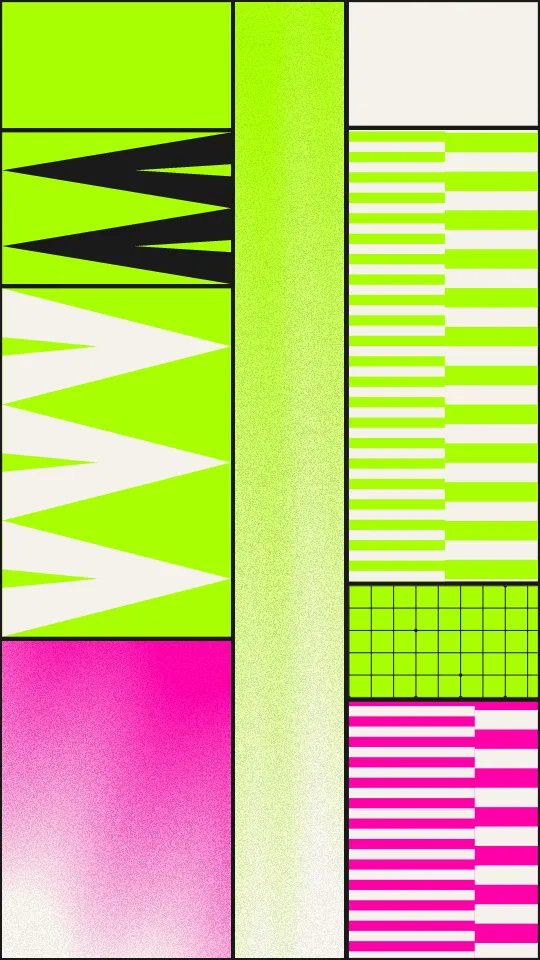
Seed 2, rendered by:
tirage derive --seed 2 --tool carve | tirage render --size 540x960 -o carve.pngSVG: yes. -o carve.svg writes this Still as an SVG. It is partly raster: ramp panels are drawn pixel by pixel, so the SVG holds them as embedded PNG images.
The same Seed 2, encoded at 360x640 by:
tirage derive --seed 2 --tool carve | tirage encode --size 360x640 -o carve.mp4Parameters
Section titled “Parameters”From tirage tools, without the 11 shared dither and grain Parameters:
carve 36 frames, svg cuts 1..=16 step 1 uneven 0..=1 step 0.01 gap 0..=1 step 0.01 mix 0..=1 step 0.01 pitch 0..=1 step 0.01 grain 0..=1 step 0.01 [no Taste] nodes 0..=1 step 0.01A Seed draws every Parameter listed except grain, each across its full range. cuts is how many times the frame is split and uneven how far each split strays from the middle. gap opens a gutter between panels. mix is the chance that a panel gets a pattern, pitch sets the stripe width and nodes the grid density. grain, the noise in the ramp panels, stays at 0.5.
The Palette takes any number of inks from 2. The first ink is also the ground. Each panel picks its two inks by position from the whole Palette.